
| Air handler location | Where the stain appears | What to check |
|---|---|---|
| Closet | Closet floor, hallway carpet, baseboards outside the door | Drain pan and the line outlet. Look for standing water in the pan. |
| Garage | Wall next to the unit, floor at the base, ceiling drywall below the unit | The pan, the float switch and the drain line connection. |
| Attic | Brown ceiling stain below the unit, drips from light fixtures | The pan above the ceiling and the line leading out. Leave the attic walk to a technician if it is hot. |
| Outdoor coil and line | Water pooling at the pad, damp exterior wall | The condensate outlet and any clogs at the end of the line. |
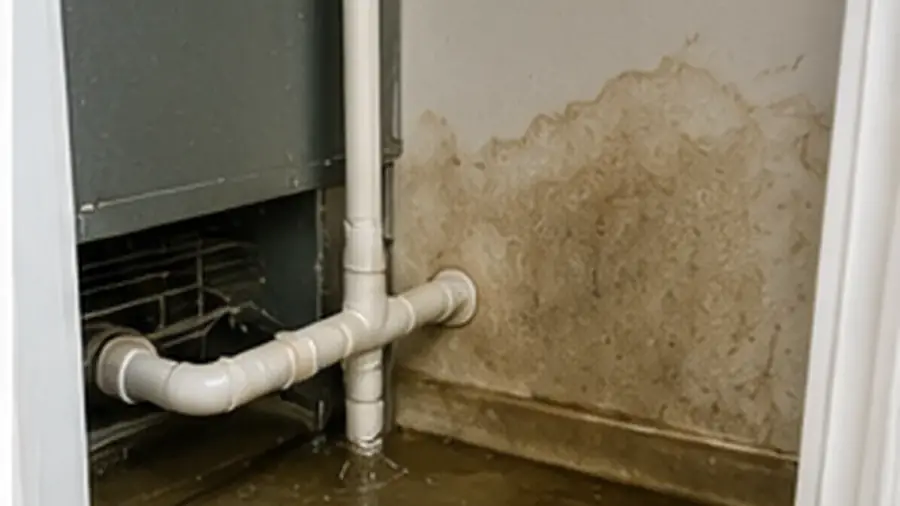
AC leak water damage in Vero Beach usually starts with something small. The condensate line that carries water away from the coil gets clogged with algae, and the pan fills and spills. Your system keeps running, so water keeps moving.
The result is a brown ceiling stain, a wet closet floor or a damp wall that nobody can explain. We dry the damaged area, check for mold and show you what to ask your HVAC technician so it does not repeat.
Typical water category
Usually 1 or 2
Mold timing
Builds in dark closets and ceiling cavities
Do this first
Turn the AC off at the thermostat and the breaker
Call us if
A ceiling stain grows or a closet floor is wet
Signs your AC is leaking water
- A stain on the ceiling that grows when the AC runs
- Water in the drain pan or around the air handler
- Musty smell near vents or in the AC closet
- Rust on the pan or the unit base
- AC that shuts off by itself because a float switch tripped
- Damp insulation around the line set
Why AC drains clog so often here
An air conditioner in Vero Beach can run for most of the year and removes a lot of water from the air each day. That water has to go somewhere. Warm, humid air means algae grow quickly inside the drain line, and a line that has not been cleared in a year or two can clog.
Because our humidity stays high, a ceiling or closet that gets wet from an AC leak does not dry easily by itself. Keeping the system off while it is wet helps, but a dehumidifier makes the difference.
How we handle AC water damage
- Turn the system off. Turn the AC off at the thermostat and the breaker. That stops it from sending more condensate into the pan.
- Find the wet area. A thermal camera and moisture meter show how far water traveled in the ceiling, wall or closet.
- Remove wet materials. Soaked ceiling drywall and insulation come out where they are too wet to dry in place.
- Dry and dehumidify. Air movers and dehumidifiers run until the readings are back to normal, with the house kept sealed from outside air.
- Mold check and handoff. We check cavities and the closet for mold before repair, and tell you what the HVAC technician should clean or replace.
Common AC leak causes and fixes
| Cause | What happens | Who fixes it |
|---|---|---|
| Clogged condensate line | Pan fills and overflows | HVAC technician clears the line |
| Cracked or rusted pan | Water drips past the pan | HVAC technician replaces the pan |
| Failed float switch | No shutoff when the pan fills | HVAC technician replaces the switch |
| Dirty filter and frozen coil | Ice melts and overflows the pan | Replace the filter, then call HVAC if it repeats |
| Wet building materials | Ceiling, insulation and wall stay damp | We dry and check for mold |
Keeping the AC from leaking again
Our work covers the water damage, not the air conditioner. Your HVAC technician can clear the line, test the float switch and inspect the pan. Some homeowners have the line flushed on a schedule, and some add a second shutoff switch so a clog stops the system before the pan overflows.
A clean filter helps too. A dirty one can freeze the coil, and the melt-off can overrun the pan. Ask your technician what suits your system.
Questions about ac leak water damage
SafetyShould I keep running the AC if the ceiling is stained?
Leave it off until the drain line is cleared, since every cycle sends more water into the pan. With visible mold or a musty smell, keep it off even after that, because the blower can carry spores into other rooms.
MoldCan an AC leak cause mold in the walls?
It can. The area around an air handler is usually dark and warm, and wet insulation holds water. Mold can begin to grow within 24 to 48 hours, so we check those spaces.
CostWill cleaning the drain line fix the damage too?
No. Clearing the line stops the leak, and the wet ceiling or wall still has to be dried and possibly repaired. Those are two separate jobs with two separate costs.
InsuranceIs AC water damage usually covered?
It depends on the policy and on whether the leak was sudden or slow. Many policies cover the resulting damage but not the repair of the AC itself. Check with your agent. We document readings and photos you can share.
Drying timeHow long does it take to dry a ceiling after an AC leak?
Often several days. Insulation above the drywall holds water, so we check above the ceiling as well as the surface.